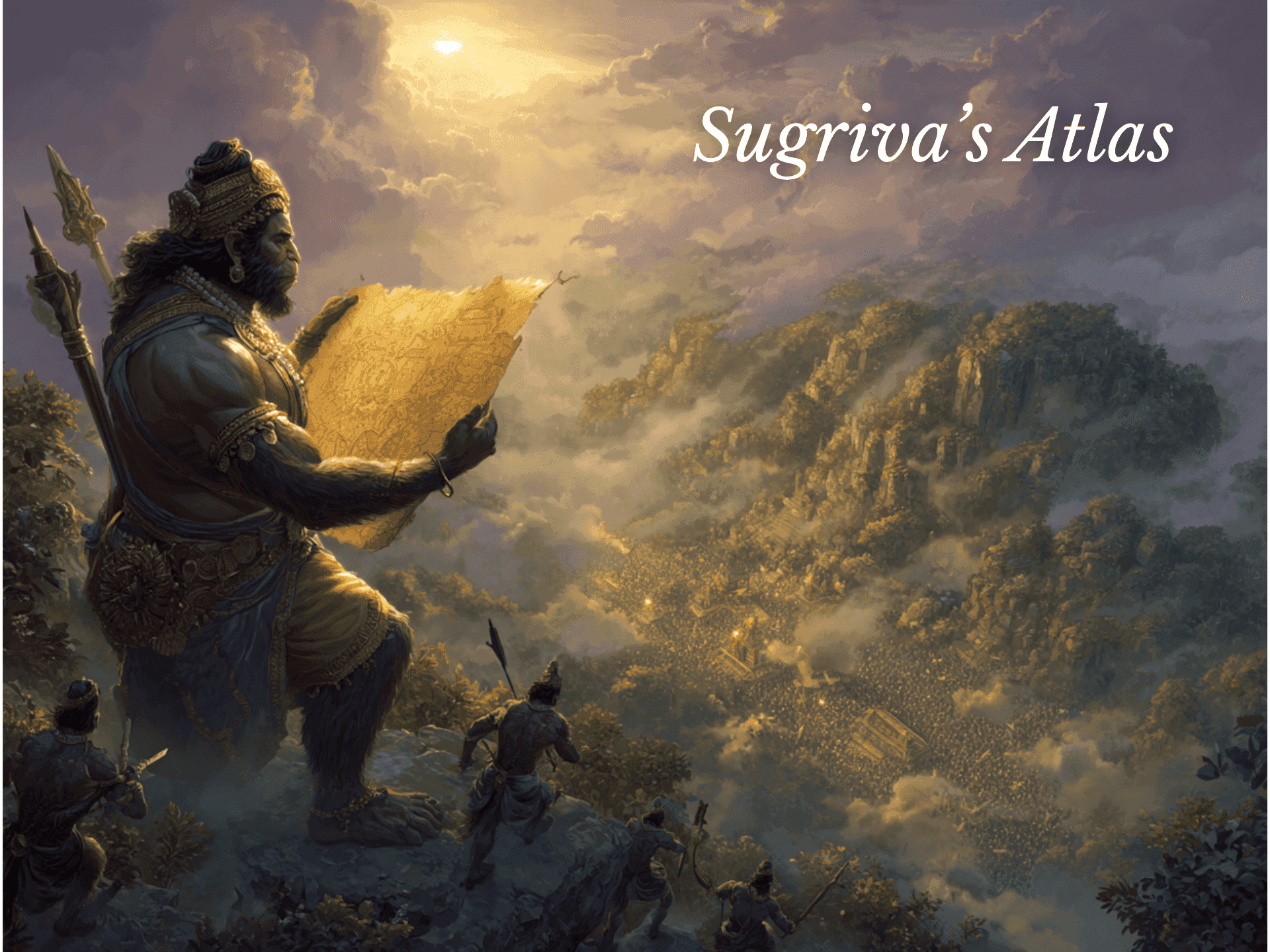
Sugriva's Atlas
Mapping the Unknown
“The search itself generates the map.”
The Journey
From Raw Facts to Lived Wisdom
Overview
When Sugriva organized the search for Sita, he revealed an extensive atlas of the known world. This represents the essential work of mapping before acting - understanding the terrain before the mission.
Reconnaissance
Systematic exploration of unknown territory before committing resources
Mental Mapping
Building internal representations of complex systems to navigate them effectively
Distributed Search
Parallel exploration of multiple directions when the target location is unknown
Raw Facts & Sources
The foundation. Verified facts, primary sources, and direct quotes that form the bedrock of understanding.
What do we know for certain?
Key Facts
- Sugriva dispatched search parties to all four directions with detailed geographic knowledge
- The Ramayana contains surprisingly accurate descriptions of distant lands
- Ancient Indian merchants had extensive trade networks reaching Southeast Asia
- Cartographic knowledge was held by merchant and warrior classes
Source Quotes
“The map is not the territory, but without maps we cannot navigate territories.”
— Adapted from Korzybski via Ramayana principle
Sources
Context & Structure
Facts organized into meaning. Historical context, core concepts, and why this matters now.
What does this mean?
Historical Context
Ancient civilizations developed sophisticated geographic knowledge through trade, conquest, and pilgrimage - often more extensive than commonly assumed.
Modern Relevance
In complex problem spaces, the discipline of mapping before acting prevents wasted effort and reveals hidden paths.
Patterns & Connections
Insights that emerge from information. Mental models, cross-domain connections, and what most people get wrong.
What patterns emerge?
Key Insights
Systematic mapping precedes effective action
Unknown territories require parallel exploration, not sequential search
Local knowledge (the vanara scouts) often exceeds centralized expertise
The search itself generates the map
Mental Models
Action & Transformation
Knowledge applied to life. Practical applications, daily practices, and warning signs when you drift.
How do I live this?
Practical Applications
When: Starting a new project or domain
→ Dedicate time to mapping the landscape before committing to a path
✓ Avoid costly pivots and discover non-obvious routes
When: When feeling lost in complexity
→ Stop moving and start mapping - draw out what you know and don't know
✓ Clarity about where to focus exploration
When: When a team is misaligned
→ Create a shared map - often disagreements stem from different mental models of the territory
✓ Alignment through shared understanding
Reflection Questions
What territory am I navigating without a map?
Where am I assuming the map is the territory?
Who are the local scouts I should be consulting?
Daily Practice
Before diving into work, spend 5 minutes sketching the landscape of what you're trying to accomplish.
Warning Sign
When you keep getting lost in the same ways, you need a better map.